Most outstanding
Stoney Creek bridge
The great bridge
- WhatA bridge over the falls
- Map saysMost outstanding feature
- Look forThe curved span
Guides
Language
Currency
See what is openfrom $144 · cancelling is freeYour stop on the map
The quick take
The Kuranda Scenic Railway history runs from a start in 1887 by one account and 1886 by another to the arrival at Kuranda in 1891, after 15 tunnels, 55 bridges and more than 150 cuttings.
History essentials
Open 15 stops
Choose a route, then tap a pin or stop for its note and a Google Maps link.
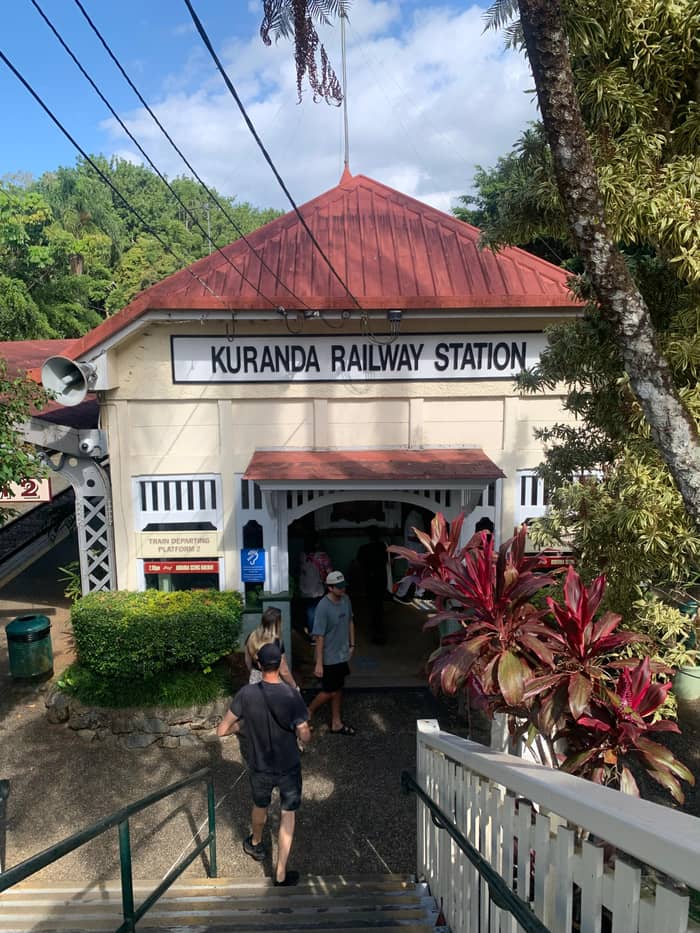
The station was built in 1915, and the village website calls it the prettiest railway station in Australia.
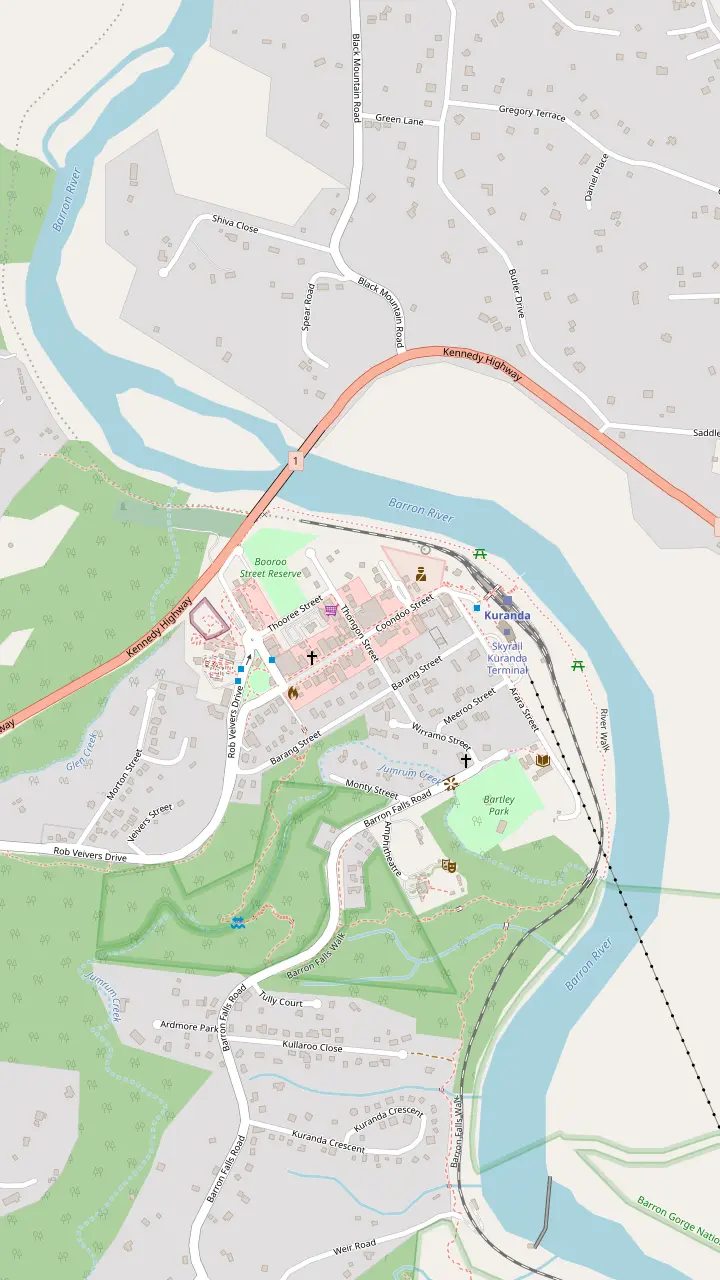
Google MapsThe Skyrail terminal stands next to the railway station, a short walk from the village.
Google MapsThe Visitor Information Centre is open 7 days, from 10 AM to 4 PM.
Google MapsThe Original Rainforest Market is open Monday to Sunday, 10 AM to 3 PM.
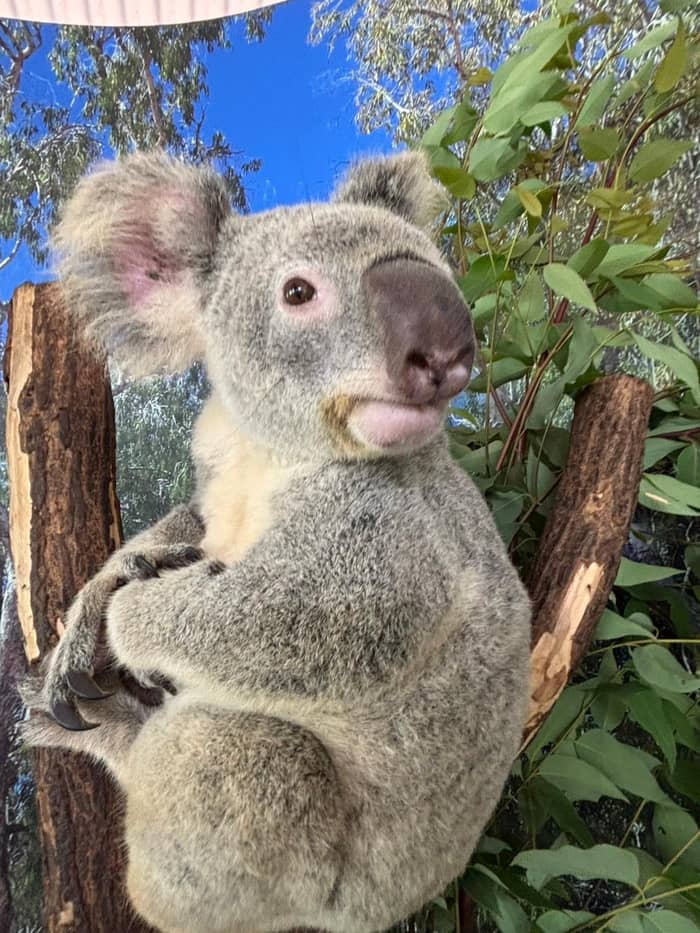
Google MapsThe Heritage Markets are a 15 minute walk from the station and the Skyrail terminal, and Birdworld and Koala Gardens sit inside them.
Google MapsThe sanctuary is home to over 1,200 tropical butterflies in an all-weather experience.
Google Maps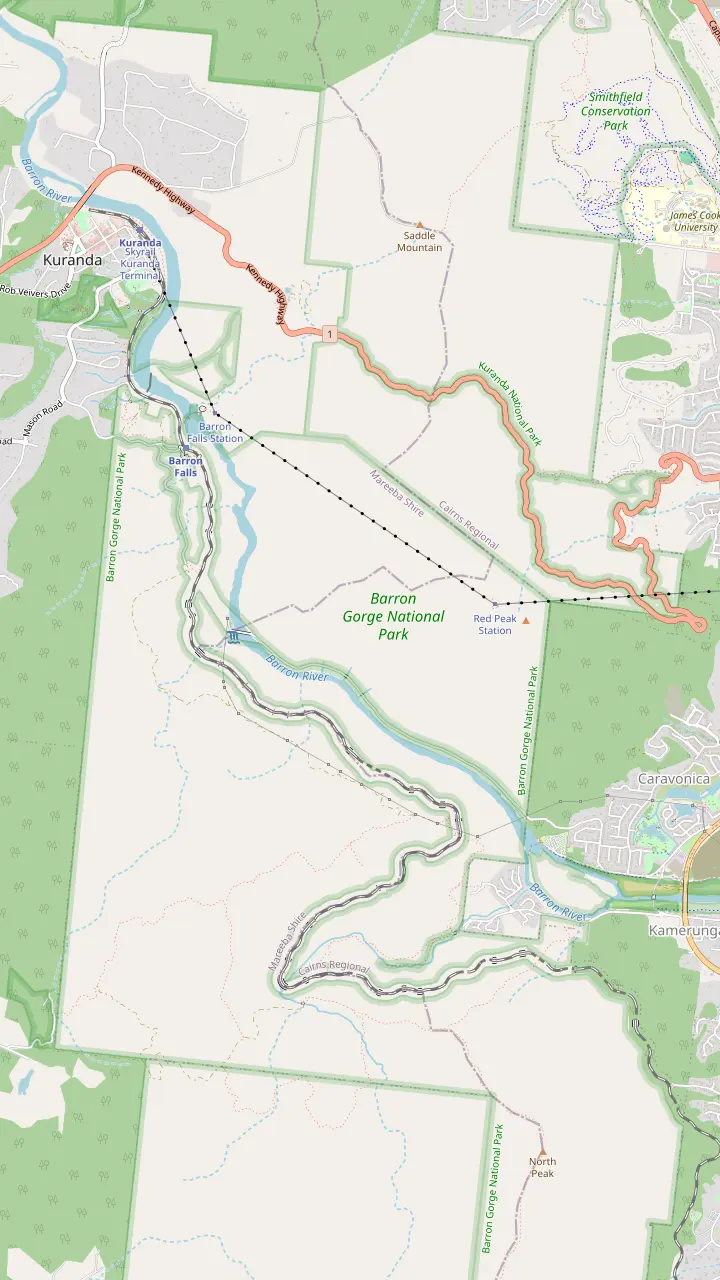
Skyrail's Edge Lookout looks out over the gorge and the waterfall.
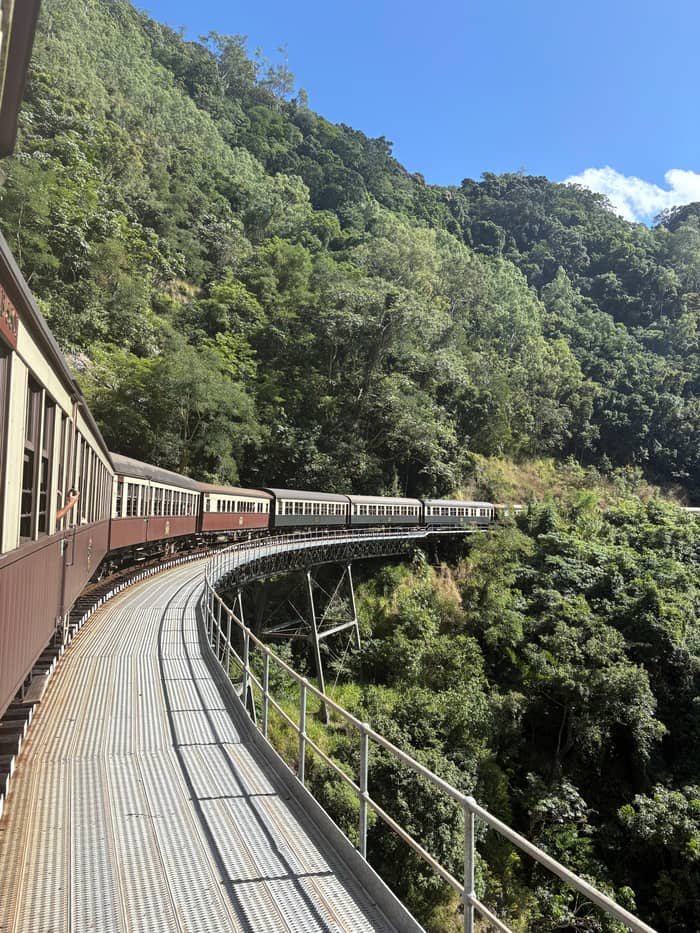
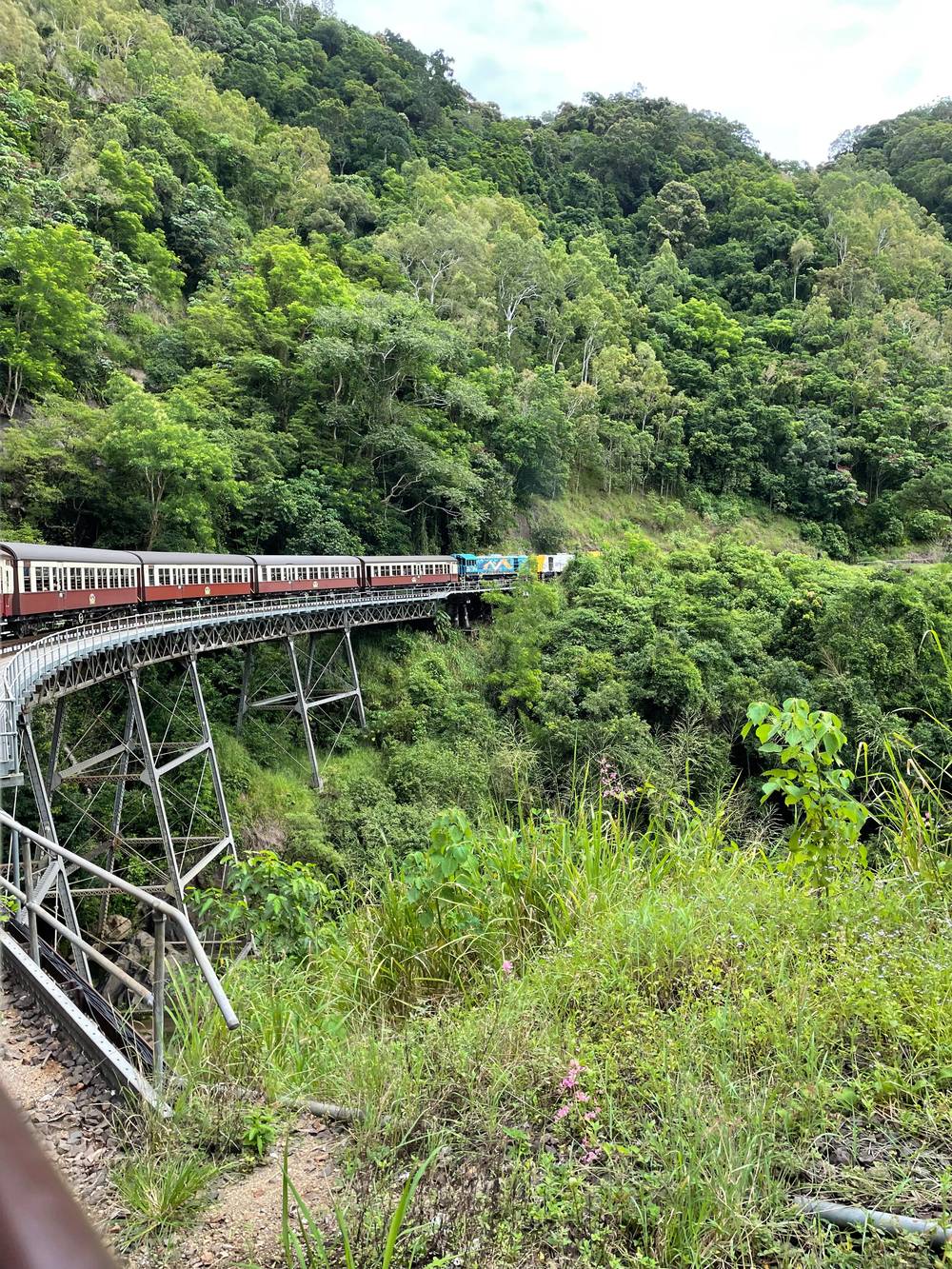
Google MapsThe railway bridge at Stoney Creek Falls is the most outstanding feature of the line.
Google MapsSkyrail suggests about 20 minutes at Red Peak.
Google MapsThe lookout on the Kennedy Highway gives a view of Cairns and the coast.
Google MapsRainforestation is on the Kuranda Range Road, about a 35 minute drive from the heart of Cairns.
Google Maps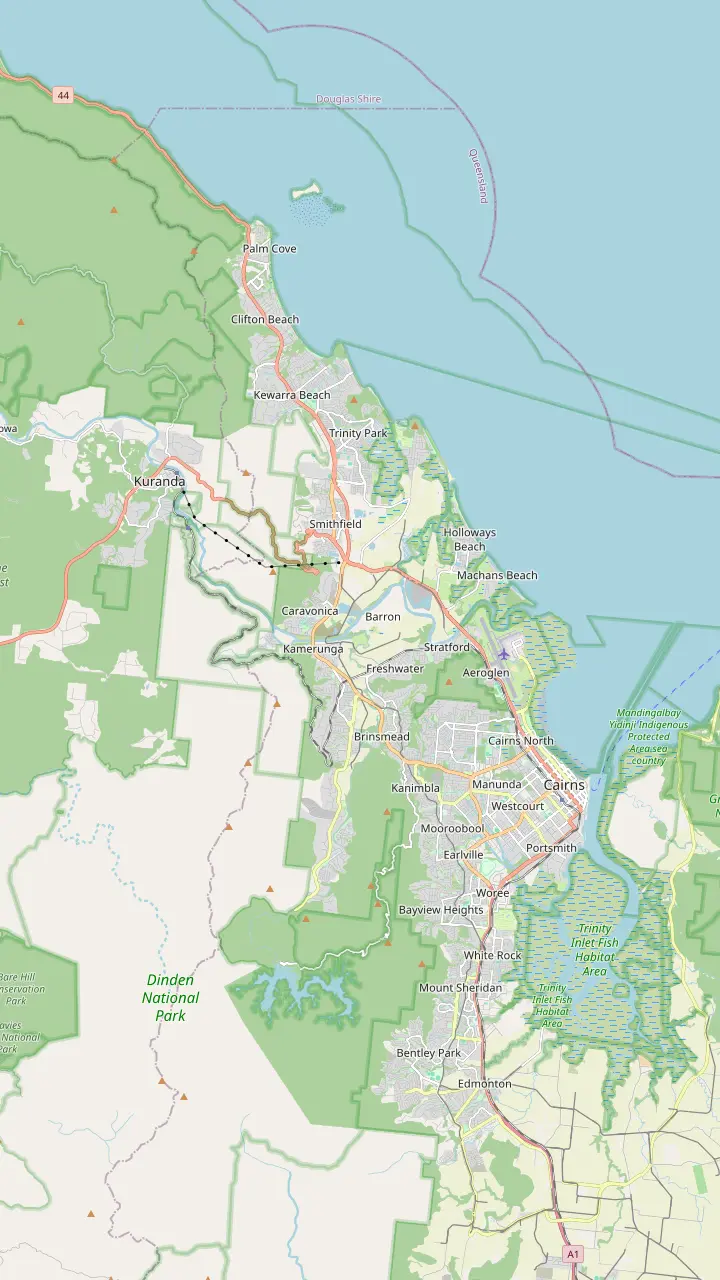
The first train leaves Cairns at 8:45 AM and the second at 9:30 AM.
Google MapsFreshwater is the first stop on the line and its most popular tourist departure point.
Google MapsSkyrail's base is 15 minutes north of Cairns city.
Google MapsKuranda sits about 330 m above sea level on the McAlister Range.
Google MapsMap data from © OpenStreetMap contributors
The Kuranda Scenic Railway history starts in the mining towns of the tableland and ends with a map of stops you can still see. Here is how the line was built and where it goes.
Editorial team, kurandatour.quest · Updated November 7, 2026 · A 6 min read
The essentials
The Kuranda Scenic Railway was never meant to be a tourist attraction. The Kuranda village visitor site explains that the mining population at Herberton was growing and supplies had to travel to and from the coast, so a railway route was planned.1 The line was a freight and passenger lifeline between the coastal plain at Cairns and the tableland behind the range.
Engineers Australia, which lists the railway on its engineering heritage register, says the line opened up mining and farming country in Far North Queensland, and that it was designed and supervised for the Queensland Government Railways by the engineers Willoughby Hannam and T H Annett.7 The register records the building as work by the contractor John Robb and his migrant workforce between 1886 and 1891.3
Two sources, two start dates. The Kuranda village site says building from Cairns ran for several years from 1887 and reached Kuranda in 1891, while Engineers Australia dates the building to between 1886 and 1891.2,3 Neither page explains the difference, and we do not guess; both agree on the end date of 1891.
Key dates
| Milestone | Date | Source | Detail |
|---|---|---|---|
| Building starts | 18872 | Village site2 | Engineers Australia says 18863 |
| Reaches Kuranda | 18912 | Village site2 | Opened without fanfare8 |
| Station built | 19159 | Village site9 | Historic Kuranda Railway Station9 |
| Hydro power | 193510 | Village site10 | Queensland's first hydroelectric station10 |
Dates are quoted as each source gives them; where sources differ, both are shown.2,3
On its climb through the rugged Barron Gorge, the State Library of Queensland counts 15 tunnels, 55 bridges and over 150 cuttings.4 It calls the work a supremely difficult feat of engineering, and puts the bill to the Queensland Government at more than 1 million pounds, with a further price paid by the workers.13
The human cost is stated plainly: some 32 men were killed in accidents during construction.14 The completion of the line, the library adds, is largely credited to the contractor John Robb, who with the government engineers found a way through the unstable ground and tropical weather, which is the achievement behind every curve you ride today.5
Robb is remembered on the line itself. The journey map lists Robbs Monument, a rock formation kept in place when the line was cut, as a memorial to John Robb.15 It is the kind of detail that turns a pretty ride into a story, and it is one of the landmarks on the route map that you can look for from the window as the train climbs, long before the village comes into view.
The railway opened quietly. The State Library of Queensland quotes the Cairns Post of 27 June 1891, which reported that the line had opened on the previous Thursday with no ceremony at all, and that locals could be forgiven some disappointment at the lack of fuss.8 The newspaper had expected a public holiday and excursion fares to mark an important epoch for Cairns.
Skyrail writes that the railway has been in operation since 1891, and the Kuranda village site says the line from Cairns reached Kuranda that year.20,2 A line that has run since then has become part of the landscape of the range, and the timetable and the carriages are the living part of that history, so a ride is a way of reading it.
Even the station has a date. The Kuranda village site states that the historic Kuranda Railway Station was built in 1915, after the track had already reached the village.9 The station is the end of the ride for most visitors, and it is where our guide to the village and its markets begins, with the gardens and the platform worth a few minutes before you head into the lanes.
A short chooser
Answer by interest, and see which part of the line the sources point you to.
If I like engineering
Watch the bridges and tunnels
The line needed 15 tunnels and 55 bridges.4
If I like human stories
Look for Robbs Monument
The rock was left as a monument to the contractor John Robb.15
If I like waterfalls
Stop at Barron Falls
The map calls Barron Falls a photographic stop on the line.19
If I like wartime history
Read about the camps
The railway serviced huge camps and hospitals.11
If I just want the ride
Our listing
It takes the train up the range and Skyrail down again.
Landmarks on the line
Most outstanding
The great bridge
The sharp curve
A 180 degree bend
A memorial
A rock left in place
The Kuranda Scenic Railway stops are set out on Queensland Rail's journey map, the best short description of the route. Cairns Railway Station is the starting point, Freshwater Railway Station is the first stop, and the line then climbs through a series of landmarks: Jungara, with a 180 degree bend, and the Stoney Creek Falls bridge, which the map calls the most outstanding feature of the railway line.6,42,40
Then come Robbs Monument and the Barron Falls stop, a photographic stop with views of the falls, before Kuranda Railway Station, which the map presents as the village in the rainforest, with its wildlife attractions and markets.15,19,43 Heritage Class passengers can stop and disembark at the Din Din (Barron Falls) station.44
The climb that links these stops is measured at 323 m in 21.7 km by Engineers Australia, and at 327 metres from sea level by the Kuranda village site, a small difference of rounding or of the point measured.16,17 The village itself is described as sitting 330 m above sea level on top of the McAlister Range.18 The map block on this page pins the stops so that you can see the route as a whole, from the coastal plain to the village.
Work out the bill
Pick a party size and see the from price of each packaged day with the train.
Weigh up 4 options
Pick a party size and see the from price of each packaged day with the train.
≈
View≈
View≈
View≈
ViewAll amounts are from-prices on GetYourGuide, converted at the ECB reference rate. Exact prices are shown at booking.
The line through time
1886 or 1887
The village site says 1887, and Engineers Australia says building began in 1886.2,3
1891
The line from Cairns reached Kuranda in 1891, opened without a fanfare.2,8
1915
The historic Kuranda Railway Station was built in 1915.9
1935
The Barron Gorge Hydroelectric Power Station opened as Queensland's first.10
World War 2
The railway serviced huge camps and hospitals.11
Today
Trains depart twice daily all year, except Christmas Day.12
The railway had a second career in the world wars. Engineers Australia notes that during World War 2 it serviced huge camps and hospitals, and the Kuranda village site adds that the Kuranda Hotel was used as a medical centre and hospital by Army Field Ambulance Units.11,45 A line built to carry supplies for the tableland became a supply route for troops, and the hospital in the village shows how much of daily life ran through the station.
The power station nearby tells a parallel story. The Kuranda village site records that the Barron Gorge Hydroelectric Power Station opened in 1935 as Queensland's first hydroelectric power station.10 The same gorge that carried the railway also gave the region its first source of such electricity, which is worth remembering when the cableway passes over it on the way down, with the rock walls close below the gondola.
Today the railway is run by Queensland Rail with heritage carriages and a timetable of its own, with trains twice a day all year except Christmas Day.12 That is a long way from a mining supply line, but the route, the tunnels and the bridges are the ones the workers left, and they are what you are looking at through the window.
Video
Channel 5 on YouTube · Tap play to load the video; not before.
The line was opened on Thursday last without any flourish of trumpets whatever
Before you ride
Start with the structures. The train winds through 15 hand-made tunnels and over 55 bridges, according to the Kuranda village site, and the Stoney Creek Falls bridge is the one the journey map singles out.46,40 Count the tunnels if you like, but the better game is to spot the cuttings, since there are said to be more than 150 and they are easy to miss.4
Then watch the waterfalls and the gorge walls on the way. Barron Falls is known as Dindin to the Djabuganydji people, and Skyrail describes it as a sacred place that has featured in their storytelling for thousands of years.47 Stand at the Barron Falls stop with that in mind, and the view reads as more than a photograph, and be respectful of the people for whom the place is sacred.
If you want to ride the line, our listing takes the Kuranda Scenic Railway up the range and returns by Skyrail. It starts from $144 and offers free cancellation up to 24 hours before. The Kuranda Scenic Railway map on this page shows the stops again, and the railway page and the tickets page cover the carriages and the fares in more detail.
FAQ
The State Library of Queensland also counts 55 bridges and more than 150 cuttings.4
The State Library of Queensland gives the cost to the Queensland Government treasury.13
The library says they were killed in accidents during construction.14
It was left during the building of the line as a monument to John Robb.15
Sources
Related guides
Questions about the Kuranda trip? A real person answers here.